
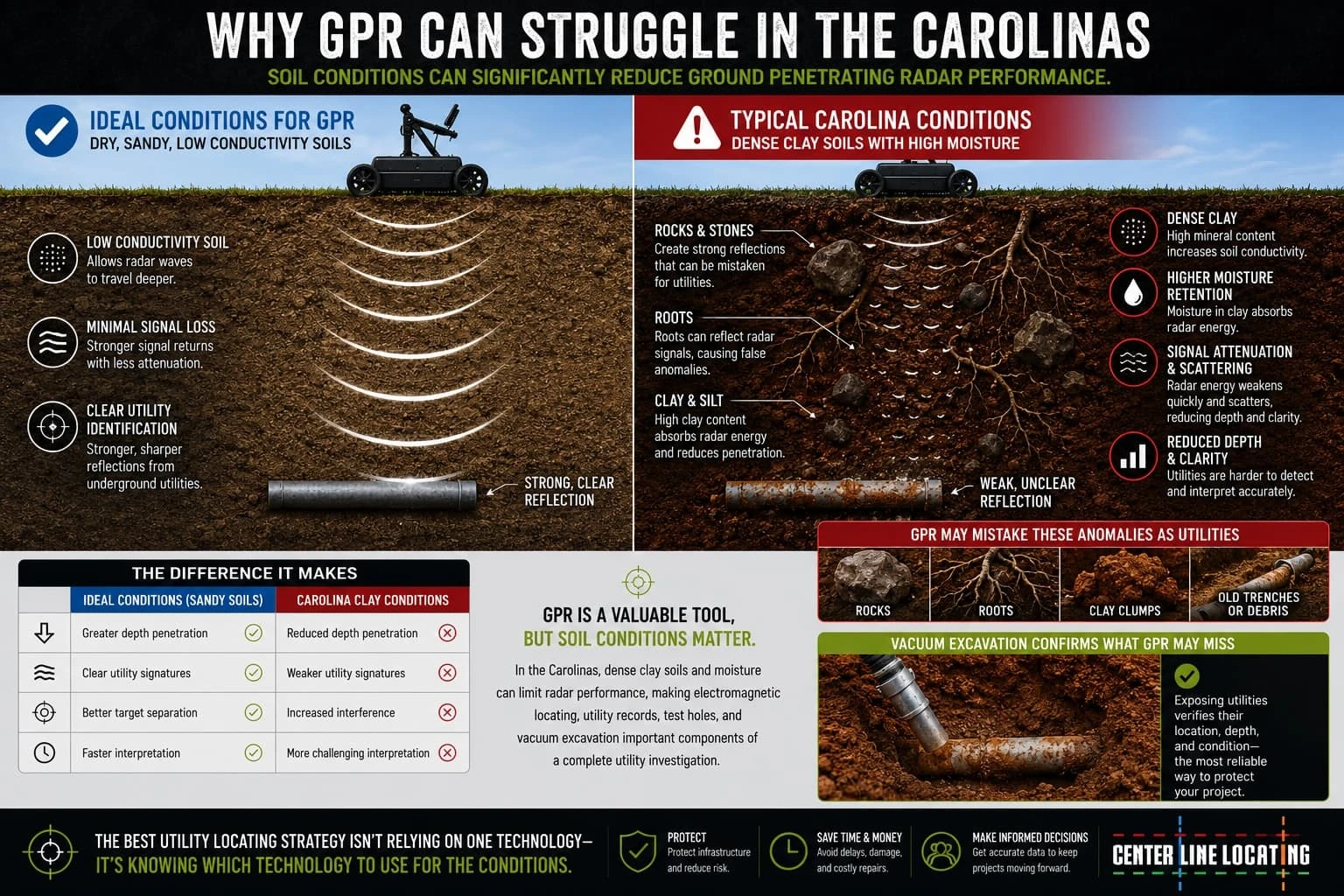
I've been in this industry long enough to see trends come and go. One that frustrates me is the marketing of Ground Penetrating Radar (GPR) as a standalone solution to underground utility challenges.
The Tool vs. The Solution
GPR is a remarkable technology. It can detect utilities, voids, and anomalies that other methods miss. But here's what the marketing often leaves out: GPR has significant limitations. It doesn't work well in certain soil conditions. It can't definitively identify what a utility is made of. And it requires skilled interpretation to be useful.
At Center Line Locating, we use GPR when it's the right tool for the situation. But we also use electromagnetic locating, CCTV inspection, soft dig verification, and sometimes just good old-fashioned research and experience.
Outcomes Over Equipment
When a client comes to us, they don't need GPR—they need accurate utility data. They need to know what's below their property, where it runs, and how deep it is. The method we use to get that information is secondary to the quality of the results.
This is why we don't list GPR as a primary service. It's a tool in our toolkit, not a product we sell. When you hire Center Line, you're hiring expertise in solving underground utility problems, not renting equipment.
The Right Approach for Your Project
Every site is different. Soil conditions vary. Utility materials differ. Site access and project constraints create unique challenges. A responsible utility locating company evaluates each situation and applies the appropriate methods.
Sometimes that's GPR. Sometimes it's electromagnetic locating. Often it's a combination. And sometimes the right answer is soft dig verification to physically confirm what's there.
The goal isn't to use fancy equipment—it's to deliver accurate, verified utility data that you can trust.
That's what we're here for. That's what we've built this company around. And that's what I expect from every project we take on.