
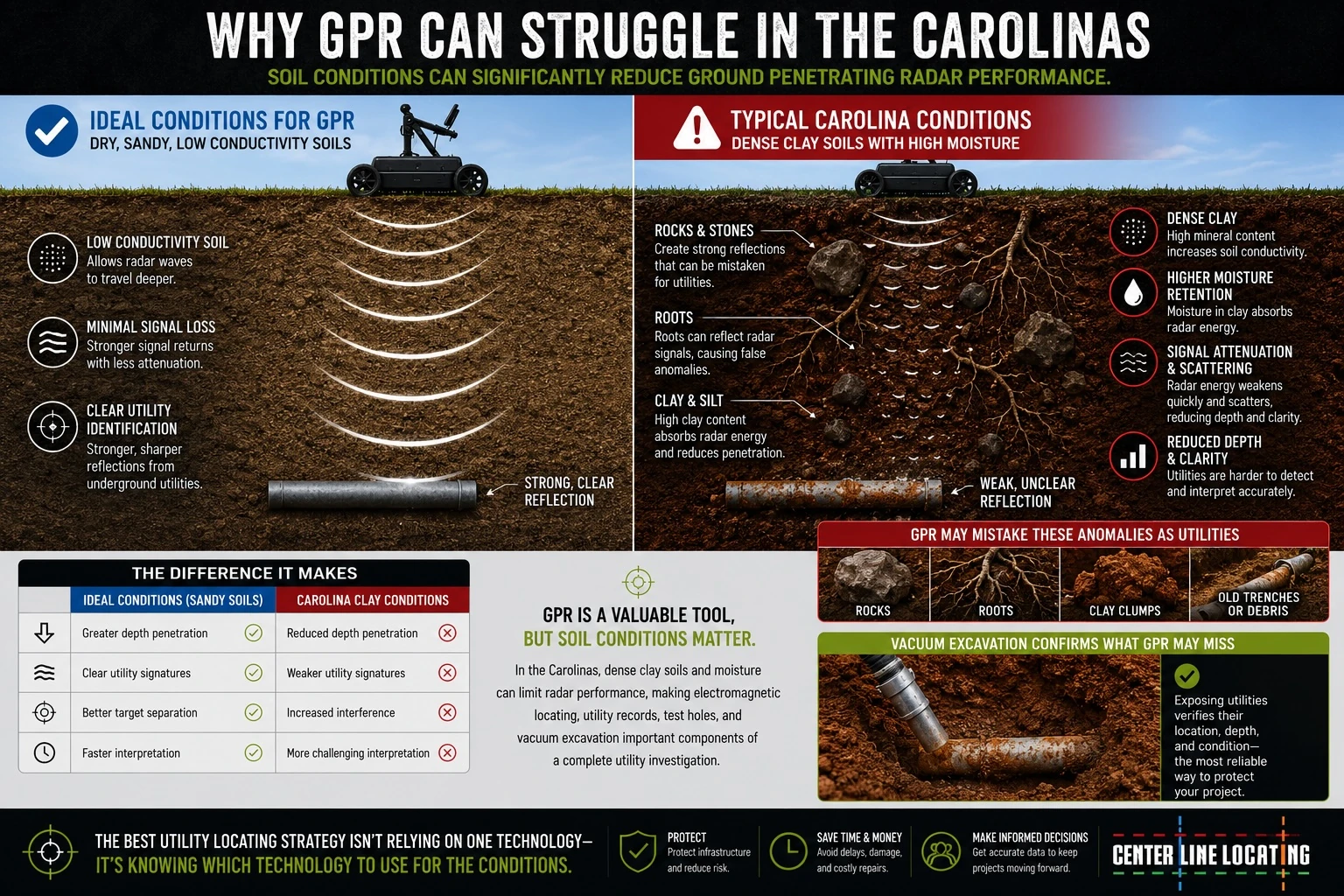
When project teams think about underground utility investigation, ground penetrating radar often comes up early in the conversation. It's a recognized technology, and in the right conditions it performs well. But conditions matter — and in the Carolinas, the soil conditions that define most project sites are exactly the kind that limit what GPR can reliably deliver.
Understanding why that happens, and what a complete utility investigation actually looks like here, is something every surveyor, engineer, and contractor working in the Charlotte metro and across the Carolinas should have a clear picture of before breaking ground.
What GPR Does Well — and Where It Was Designed to Work
Ground penetrating radar works by sending radar energy into the ground and reading what reflects back. In ideal conditions — dry, sandy, low-conductivity soils — radar waves travel deep, return strong reflections, and produce clear utility signatures that experienced operators can interpret with confidence.
Those conditions exist in parts of the country. The Carolinas are generally not one of them.
The Carolina Soil Problem
The dominant soil profile across much of Charlotte, the Piedmont, and the broader Carolina region is dense clay with high moisture retention. That combination is the opposite of what GPR needs to perform.
Dense clay has high mineral content that increases soil conductivity. Moisture in clay actively absorbs radar energy. The result is signal attenuation — radar energy that weakens quickly and scatters before it can return a usable reflection. Depth penetration is reduced. Utility signatures become weaker and harder to separate from background noise.
And the interference isn't just from the soil itself. Carolina soils introduce additional anomalies that GPR can mistake for utilities — rocks and stones that create strong false reflections, root systems that scatter radar signals, clay clumps and old trench lines that read like buried infrastructure. An operator looking at a GPR scan in these conditions is working with degraded data and a higher likelihood of misinterpretation.
That's not a failure of the technology or the operator. It's a soil condition problem — and it's the reality of working in this region.
What a Complete Utility Investigation Looks Like Here
Center Line Locating's position is straightforward: the best utility locating strategy isn't relying on one technology. It's knowing which tools to deploy for the conditions on the ground.
In the Carolinas, that means building investigations around electromagnetic locating as the primary method for identifying and tracing underground utilities. Electromagnetic locating doesn't have the same sensitivity to clay soils and moisture that limits GPR. It's the method our crews use every day across Charlotte and the surrounding region — on commercial sites, residential properties, and civil projects — to produce field-verified utility data that engineers and contractors can actually plan from.
When the goal is confirmation — exposing a utility to verify its exact location, depth, and condition — vacuum excavation is the answer. Soft dig exposes what's there without the risk of mechanical damage, giving your project team ground truth that no surface-based technology can match. For pre-construction work, critical crossings, or any situation where the cost of being wrong is high, vacuum excavation is the most reliable way to protect your project and keep it moving.
What This Means for Your Project Team
If you're a surveyor integrating utility data into topo or boundary work, you need positions you can stand behind. Electromagnetic locating delivers field-verified data that integrates cleanly into your package.
If you're an engineer planning a site, you need utility information that reflects what's actually in the ground — not what records suggest might be there. Our crews combine electromagnetic locating with GPS mapping and clear documentation that fits the way your project is already set up.
If you're a contractor going into construction, pre-construction utility investigation eliminates the kind of surprises that stop jobs. Knowing what's below before you dig is how you protect your crew, your schedule, and your budget.
CLL's Approach to Every Project
Damage prevention means taking any and all jobs, understanding them fully — whether it's a commercial property, a residential lot, or a civil project — and communicating clearly with clients and utility owners to ensure all facilities are known, found, and protected. That's the standard we hold ourselves to on every locate.
GPR is a valuable tool. In the right conditions, it has a role in a complete utility investigation. But in the Carolinas, dense clay soils and moisture make electromagnetic locating, utility records, test holes, and vacuum excavation the essential components of an investigation you can trust.
Know the conditions. Use the right tools. That's how projects in the Carolinas stay on track.
Request a Locate or Soft Dig
Center Line Locating supports project teams across Charlotte, the Carolinas, and the Southeast with private utility locating, GPS mapping, and vacuum excavation services. Request a locate or request a soft dig, or call 704-315-5820.